
Care Guides · Aquatics
Puffer Fish Care Guide: Figure 8, Pea Puffers, and Green Spotted Puffers
Puffers are intelligent, personable, and endlessly entertaining — but they're not community fish. Everything you need to know about the three most popular puffer species.
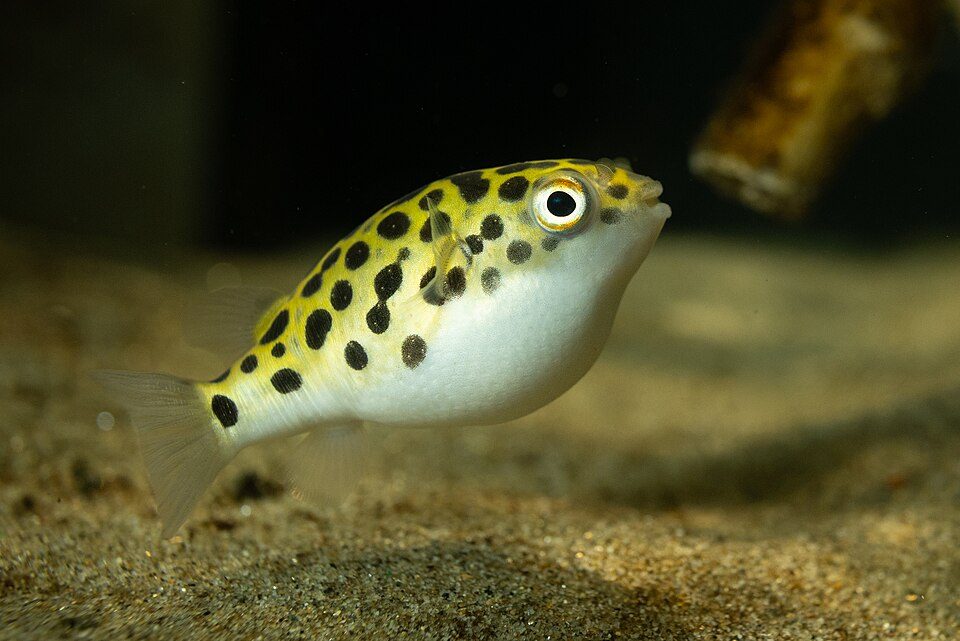
Photo: Green spotted puffer, Tails & Scales
Puffer fish are unlike any other fish you'll keep. They're intelligent, curious, and have genuine personalities — they'll recognise you, beg for food, and watch you with those extraordinary rotating eyes. They're also nippy, territorial, and in some cases require brackish water. They are not community fish.
But for the keeper who understands what they're getting into, puffers are some of the most rewarding fish in the hobby. This guide covers the three species you're most likely to encounter: the figure 8 puffer, the pea puffer (murder bean), and the green spotted puffer.
Pea Puffer (Carinotetraodon travancoricus) — The Murder Bean
Don't let the name fool you. The pea puffer is the smallest puffer species in the world — adults reach just 2.5–3.5cm — but they have the attitude of a fish ten times their size. The "murder bean" nickname is affectionate but accurate: they will absolutely shred the fins of any fish slow enough to be caught.
Water Parameters
Pea puffers are fully freshwater fish. This makes them the most accessible puffer for most hobbyists.
- Temperature: 24–28°C
- pH: 7.0–8.0
- Hardness: 5–25 dGH
- Ammonia/Nitrite: 0 ppm
- Nitrate: under 20 ppm
Tank Size and Setup
A single pea puffer can be kept in a 40-litre tank, but a 60-litre is better and allows for a small group. For a group of 6–8 pea puffers, a 80–100 litre heavily planted tank is appropriate.
Pea puffers thrive in densely planted tanks. Plants provide cover, break lines of sight between individuals (reducing aggression), and create a naturalistic environment that encourages natural behaviour. Java fern, Anubias, Vallisneria, floating plants, and moss are all excellent choices.
Hardscape: driftwood, rocks, and caves add hiding spots and territory markers.
Filtration: pea puffers are sensitive to water quality. A good canister or hang-on-back filter with regular water changes (30–40% weekly) is essential.
Tankmates
Pea puffers are best kept in species-only tanks or with very carefully chosen tankmates. Their fin-nipping behaviour makes most fish unsuitable companions.
Possible tankmates (with caution):
- Otocinclus — fast-moving, armoured, generally ignored
- Nerite snails — puffers will eat them, but snails are also a useful dietary supplement
- Fast-moving, short-finned fish in large tanks
Avoid: any fish with long fins (bettas, guppies, angelfish), slow-moving fish, or any fish small enough to be mistaken for food.
Keeping multiple pea puffers: possible in a large, heavily planted tank with multiple feeding stations. Watch for aggression and be prepared to separate individuals if needed. A ratio of more females than males reduces aggression.
Feeding
Pea puffers are carnivores with a preference for live and frozen foods. Their beaks (fused teeth) grow continuously and need to be worn down by hard-shelled prey.
Staple foods:
- Frozen bloodworms — highly palatable, good as a staple
- Frozen brine shrimp — good variety food
- Live or frozen daphnia — excellent for gut health
- Snails (bladder snails, ramshorn snails) — essential for beak wear; breed a colony as a continuous supply
Occasional foods:
- Live blackworms
- Small pieces of mussel or prawn
- Frozen mysis shrimp
Feeding frequency: once or twice daily, as much as they'll eat in 2–3 minutes. Remove uneaten food promptly.
Beak trimming: if your puffer's beak becomes overgrown (visible as a protruding beak that prevents normal feeding), increase the frequency of hard-shelled prey. In severe cases, beak trimming by a vet may be necessary.
Figure 8 Puffer (Dichotomyctere ocellatus)
The figure 8 puffer is named for the figure-8 pattern on its back. It's one of the most popular puffer species in the hobby — personable, active, and manageable in size (adults reach 6–8cm). It's also one of the most frequently misrepresented fish in the trade.
Brackish Water: The Non-Negotiable
Figure 8 puffers are brackish water fish. They can survive in freshwater short-term, but they do not thrive in it long-term. Keeping them in freshwater leads to chronic stress, immune suppression, and shortened lifespan.
Brackish water is a mix of fresh and salt water, with a specific gravity (salinity) between that of freshwater and full marine water.
Target specific gravity: 1.005–1.010 (roughly 7–14 grams of marine salt per litre)
Use a proper marine salt mix (not aquarium salt or table salt) and a refractometer to measure specific gravity accurately. Hydrometers are less accurate and not recommended.
Other parameters:
- Temperature: 24–28°C
- pH: 7.5–8.5 (brackish water is naturally alkaline)
- Ammonia/Nitrite: 0 ppm
- Nitrate: under 20 ppm
Tank Size and Setup
A single figure 8 puffer needs a minimum 80-litre tank. A pair needs 120 litres or more.
Figure 8 puffers are active and curious — they need space to explore. Furnish the tank with:
- Rocks, caves, and driftwood for hiding and territory
- Hardy plants that tolerate brackish water: Java fern, Anubias, Vallisneria, hornwort
- Open swimming space in the middle of the tank
- A tight-fitting lid — puffers are escape artists
Filtration: strong biological filtration is essential. Puffers are messy eaters and produce significant waste. A canister filter rated for twice the tank volume is appropriate.
Tankmates
Figure 8 puffers are best kept alone or in species-only setups. They will nip fins and may attack tankmates, particularly in smaller tanks.
In a large brackish tank (200+ litres), some keepers successfully keep figure 8 puffers with other brackish species: archer fish, mollies (which adapt well to brackish water), and some gobies. Research any potential tankmate carefully.
Feeding
Like all puffers, figure 8s need hard-shelled prey to wear down their beaks.
Staple foods:
- Snails (bladder snails, ramshorn snails, nerite snails) — the most important dietary component
- Frozen bloodworms
- Frozen mysis shrimp
- Frozen brine shrimp
Occasional foods:
- Pieces of mussel, prawn, or crab
- Live ghost shrimp
- Frozen krill
Feed once or twice daily. Maintain a snail colony as a continuous food source — figure 8 puffers will eat snails enthusiastically and it's the best way to keep their beaks in good condition.
Green Spotted Puffer (Dichotomyctere nigroviridis)
The green spotted puffer is the largest of the three species covered here, reaching 15–17cm as adults. It's also the most demanding — juveniles can be kept in freshwater, but adults require full marine salinity. This is a fish for committed keepers.
The Salinity Progression
This is the most important thing to understand about green spotted puffers:
- Juveniles (under 5cm): can be kept in freshwater or low-end brackish (SG 1.003–1.005)
- Sub-adults (5–10cm): should be transitioned to mid-range brackish (SG 1.010–1.015)
- Adults (over 10cm): require full marine salinity (SG 1.020–1.025)
Most green spotted puffers sold in fish shops are juveniles kept in freshwater. Many buyers don't realise the fish will eventually need a full marine setup. Be prepared for this before you buy.
Transitioning salinity: increase salinity gradually over several weeks. A sudden change in salinity is stressful and potentially fatal.
Tank Size
Adults need a minimum 200-litre tank. This is a large, active fish that needs space.
Setup and Tankmates
Green spotted puffers are aggressive and should generally be kept alone. In very large tanks (400+ litres), some keepers maintain them with other robust marine or brackish fish, but this requires careful monitoring.
Setup should include:
- Robust filtration (these are messy fish)
- Plenty of hiding spots and visual barriers
- A tight-fitting lid
- For adults: a full marine setup with live rock is ideal
Feeding
The same principles apply as for figure 8 puffers, scaled up for a larger fish:
- Snails, mussels, clams, and other hard-shelled prey are essential
- Frozen foods: krill, mysis, silversides
- Whole prawns and pieces of crab
Adults can eat surprisingly large prey. A whole mussel in the shell is an excellent feeding enrichment item.
General Puffer Health Notes
Ich (white spot): puffers are scaleless and highly susceptible to ich. They're also sensitive to many medications — copper-based treatments are toxic to puffers. Use heat treatment (raise temperature to 30°C for 2 weeks) or formalin-based treatments carefully.
Beak overgrowth: the most common husbandry issue. Preventable with regular hard-shelled prey. Severe overgrowth requires veterinary intervention.
Bloating: puffers inflate as a defence mechanism. Repeated inflation is stressful and should not be deliberately induced. A puffer that inflates frequently may be stressed by its environment.
Parasites: puffers are prone to internal parasites, particularly if fed wild-caught live foods. Quarantine new fish and consider prophylactic treatment.
A Note on Sourcing
Puffer fish are sometimes wild-caught, which increases the risk of parasites and stress-related illness. Captive-bred puffers — particularly pea puffers — are increasingly available and are a better choice where possible.
We stock puffer fish when available and can advise on sourcing. Come in and talk to us about what's currently in stock and what's coming — puffers are a speciality of ours and we're happy to spend time helping you get the setup right.
These are extraordinary fish. Keep them properly and they'll reward you with years of personality-packed entertainment.
More guides
Keep reading.

Your First Planted Tank: A Beginner's Complete Setup Guide
Everything you need to know to set up a thriving planted aquarium from scratch — substrate, lighting, plants, and cycling explained simply.
Elle Jordaan · 8 min read
Betta Fish Care Guide: How to Keep a Siamese Fighting Fish Properly
Bettas are beautiful, intelligent, and deeply misunderstood. They don't belong in bowls or vases. Here's how to keep one the right way — and why it matters.
Elle Jordaan · 9 min read
Goldfish Care Guide: How to Keep Goldfish and Orandas Properly
Goldfish are not beginner fish — they're long-lived, heavy-feeding, and need far more space than most people realise. Here's how to keep common goldfish and fancy varieties like Orandas the right way.
Elle Jordaan · 12 min read