
Care Guides · Aquatics
Freshwater Shrimp Care Guide: Cherry, Blue Velvet, and 24 Karat Gold Shrimp
Neocaridina shrimp are hardy, endlessly fascinating, and one of the best clean-up crews in the hobby. Here's how to keep Cherry, Blue Velvet, and 24 Karat Gold shrimp thriving in your planted tank.
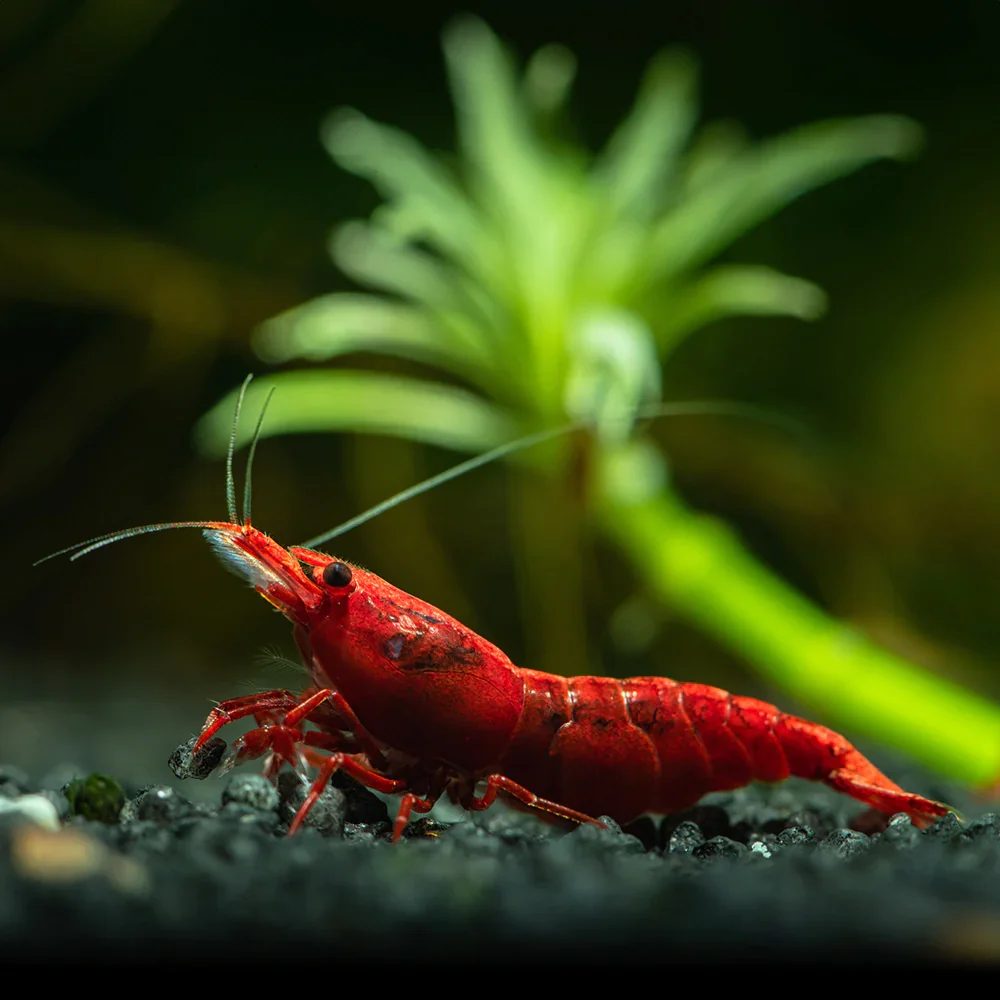
Photo: Red cherry shrimp, Tails & Scales
Why Freshwater Shrimp?
There's something almost meditative about watching a colony of shrimp work their way through a planted tank. They're constantly busy — grazing on biofilm, picking through substrate, tumbling over moss — and they do it all without bothering a single tankmate. They're also genuinely useful: shrimp are some of the best algae grazers and detritus cleaners in the freshwater hobby.
The three varieties covered in this guide — Cherry, Blue Velvet, and 24 Karat Gold — are all colour morphs of the same species: Neocaridina davidi. This is great news for beginners, because it means the care requirements are identical across all three. Master one, and you've mastered them all.
The Three Varieties
Cherry Shrimp (Red Neocaridina)
Cherry shrimp are the most widely kept freshwater shrimp in the hobby, and for good reason. They're hardy, breed readily, and their red colouration pops beautifully against green plants. Grading runs from pale pink "Sakura" through to the deep, opaque red of "Painted Fire Red" — the higher the grade, the more solid and intense the colour.
What to look for when buying: Females are larger and more intensely coloured than males. A healthy female will often have a visible "saddle" — a yellow patch behind her head where eggs are stored before fertilisation. Avoid shrimp that are pale, lethargic, or have white patches on their body.
Blue Velvet Shrimp
Blue Velvet is a blue colour morph of Neocaridina davidi, selectively bred for a vivid, even blue colouration. They're slightly less common than Cherry shrimp but just as hardy. The blue ranges from a pale sky blue in lower grades to a deep, almost electric cobalt in top-grade specimens.
Blue Velvet shrimp are particularly striking in tanks with warm-toned substrate like Seiryu stone or brown sand, where the contrast really sings. They're also excellent in heavily planted setups where the blue reads clearly against green foliage.
Important: Do not keep Blue Velvet and Cherry shrimp together. They will interbreed, and within a few generations your colony will revert to a muddy brown — the wild-type colour that underlies all Neocaridina morphs.
24 Karat Gold Shrimp
Also called Golden Back or Yellow shrimp, 24 Karat Gold is a yellow-to-golden colour morph of Neocaridina davidi. They're slightly less common than Cherry or Blue Velvet, but their warm, sunny colouration makes them a standout in any planted tank — especially against dark substrate like ADA Amazonia or black sand.
Top-grade specimens have a solid, opaque golden-yellow body with no translucency. Lower grades may show a more washed-out or translucent appearance, which is still attractive but less striking.
Tank Setup
Tank Size
A 30-litre tank is a comfortable minimum for a shrimp colony, though many keepers run successful colonies in tanks as small as 20 litres. Larger tanks are more stable — water parameters fluctuate less in a bigger volume, which is important for invertebrates that are sensitive to sudden changes.
A 60-litre planted tank can comfortably house 50–100 shrimp alongside small, peaceful fish.
Filtration
Shrimp are small and light, which means they can be sucked into standard filter intakes. Use a sponge filter, or cover your filter intake with a fine sponge pre-filter. Sponge filters are actually ideal for shrimp tanks — they provide gentle flow, biological filtration, and the sponge surface itself becomes colonised with biofilm that shrimp love to graze on.
Avoid strong flow. Shrimp don't appreciate being tumbled around, and high flow can stress a colony.
Substrate
Neocaridina shrimp are not fussy about substrate, but they do best on something that supports plant growth and provides surface area for biofilm. Options include:
- Inert sand or gravel — fine-grained, dark-coloured substrates like black sand show off shrimp colouration beautifully
- Planted tank substrates (ADA Amazonia, Tropica Soil) — excellent for plant growth, though these can initially lower pH slightly
- Bare bottom — functional but not ideal; less surface area for biofilm and less natural behaviour
Plants
Shrimp thrive in planted tanks. Plants provide cover, grazing surfaces, and help maintain water quality. Some particularly good choices:
- Java moss and other mosses — shrimp love grazing on moss and it provides excellent cover for juveniles
- Java fern — tough, low-maintenance, and provides good surface area
- Anubias — slow-growing and hardy; shrimp graze the leaves constantly
- Floating plants (frogbit, water lettuce) — diffuse light, reduce nitrates, and provide surface cover
Water Parameters
Neocaridina shrimp are the most forgiving freshwater shrimp in the hobby, but they still have preferences. The key is stability — gradual, consistent parameters are far more important than hitting exact numbers.
| Parameter | Ideal Range |
|---|---|
| Temperature | 20–26°C |
| pH | 6.8–7.8 |
| GH (General Hardness) | 6–12 dGH |
| KH (Carbonate Hardness) | 2–8 dKH |
| TDS (Total Dissolved Solids) | 150–250 ppm |
| Ammonia | 0 ppm |
| Nitrite | 0 ppm |
| Nitrate | < 20 ppm |
Cape Town tap water is generally soft and slightly acidic, which suits Neocaridina well. If your TDS is very low (under 100 ppm), consider adding a small amount of mineral supplement to bring it up — shrimp need minerals for moulting and shell development.
The Importance of Cycling
Never add shrimp to an uncycled tank. Ammonia and nitrite are lethal to invertebrates, often more quickly than to fish. Run a full nitrogen cycle before introducing any shrimp — this typically takes 4–6 weeks with a new filter.
Feeding
Shrimp are omnivorous scavengers. In a well-planted, established tank, they'll find a significant portion of their food naturally — biofilm, algae, decaying plant matter, and microorganisms in the substrate. Supplemental feeding should be modest.
Good staple foods:
- Blanched vegetables (zucchini, spinach, cucumber, sweet potato)
- Shrimp-specific pellets or wafers (Hikari Shrimp Cuisine, Glasgarten Bacter AE)
- Snowflake food (dried soy hulls — excellent for gut health)
- Dried leaves (Indian almond, mulberry, oak) — these release tannins and provide long-term grazing
Feeding frequency: Every 1–2 days is plenty. Remove uneaten food after a few hours to prevent fouling the water. Overfeeding is one of the most common mistakes in shrimp keeping — it leads to algae blooms, bacterial issues, and poor water quality.
What to avoid: Copper in any form is toxic to shrimp. Check the ingredients of any fish food or plant fertiliser you use — many contain copper sulphate. Avoid any medication that lists copper as an ingredient.
Moulting
Shrimp grow by moulting — shedding their exoskeleton and forming a new, larger one. This is a normal and essential process, but it's also a vulnerable time. A shrimp that has just moulted is soft-bodied and defenceless for several hours.
Signs of a healthy moult: The shrimp disappears for a day or two, then reappears slightly larger. You may find the empty white shell (exoskeleton) in the tank — leave it there. Other shrimp will eat it, recycling the minerals.
Failed moults (where the shrimp gets stuck in its old shell) are usually caused by mineral deficiency or poor water quality. If you're seeing failed moults, check your GH and TDS, and consider adding a mineral supplement.
Breeding
Neocaridina shrimp breed readily in good conditions. A healthy colony will grow quickly — a single female can carry 20–30 eggs, and juveniles reach breeding size in about 3–4 months.
The breeding cycle:
- A female moults and releases pheromones into the water
- Males go into a "mating frenzy" — you'll see them swimming frantically around the tank
- The female is fertilised and develops a "saddle" (visible egg mass behind her head)
- Eggs move from the saddle to under her tail, where she carries them for 3–4 weeks, fanning them with her pleopods
- Miniature shrimp hatch fully formed — no larval stage
Protecting juveniles: Baby shrimp are tiny (1–2mm) and vulnerable. Dense moss, fine-leaved plants, and a sponge filter intake cover are essential. Avoid keeping shrimp with fish that will eat juveniles — even "shrimp-safe" fish like small tetras will eat baby shrimp.
Tankmates
Neocaridina shrimp are peaceful and defenceless. Choose tankmates carefully.
Good tankmates:
- Otocinclus catfish (excellent algae eaters, completely shrimp-safe)
- Small rasboras (Chili rasbora, Exclamation Point rasbora)
- Pygmy corydoras
- Snails (Nerite, Mystery, Ramshorn)
- Other Neocaridina of the same colour morph
Avoid:
- Any fish large enough to eat a shrimp (most fish over 4–5cm)
- Bettas (many will eat shrimp, though individual temperament varies)
- Cichlids
- Loaches (most will eat shrimp)
- Goldfish
The colour morph rule: Keep only one colour morph of Neocaridina davidi per tank. Mixed morphs will interbreed and revert to wild-type brown within a few generations.
Common Problems
White ring of death
A white ring around the shrimp's body, usually at the midpoint, indicates a failed moult. The shrimp is stuck in its old shell. This is almost always caused by mineral deficiency or sudden water parameter changes. Unfortunately, there is little you can do once it has happened — prevention through stable parameters and adequate GH is the answer.
Shrimp dying after water changes
This is usually caused by a sudden change in temperature, pH, or TDS. Always match the temperature of new water to the tank, and drip-acclimate new shrimp. For water changes, use a slow drip or add water gradually over 15–20 minutes.
Shrimp not breeding
Check your parameters — particularly GH and TDS. Low mineral content is the most common reason a colony fails to breed. Also ensure you have a good male-to-female ratio (roughly 1:3 is ideal) and that the tank is well-established with plenty of biofilm.
Sudden colony crash
A sudden die-off is almost always a water quality issue — ammonia spike, nitrite spike, or copper contamination. Test your water immediately. Check any new products you've added to the tank (fertilisers, medications, dechlorinators) for copper content.
A Note on Keeping Multiple Morphs
It's tempting to keep Cherry, Blue Velvet, and 24 Karat Gold shrimp together — they're all the same species and the colour combination is beautiful. But within a few generations, the offspring will revert to wild-type brown as the colour genes mix. If you want to maintain distinct colour morphs, keep them in separate tanks.
If you're not concerned about maintaining colour purity and just want a lively, interesting colony, a mixed tank can be a lot of fun — you'll get a range of colours and the occasional striking individual.
Freshwater shrimp are one of the most rewarding things you can keep in an aquarium. They're low-maintenance, fascinating to watch, and they make your planted tank healthier. If you're thinking about starting a colony, come in and talk to us — we're happy to help you choose the right variety and set up a tank they'll thrive in.
More guides
Keep reading.

Your First Planted Tank: A Beginner's Complete Setup Guide
Everything you need to know to set up a thriving planted aquarium from scratch — substrate, lighting, plants, and cycling explained simply.
Elle Jordaan · 8 min read
Betta Fish Care Guide: How to Keep a Siamese Fighting Fish Properly
Bettas are beautiful, intelligent, and deeply misunderstood. They don't belong in bowls or vases. Here's how to keep one the right way — and why it matters.
Elle Jordaan · 9 min read
Puffer Fish Care Guide: Figure 8, Pea Puffers, and Green Spotted Puffers
Puffers are intelligent, personable, and endlessly entertaining — but they're not community fish. Everything you need to know about the three most popular puffer species.
Louis Jordaan · 12 min read